
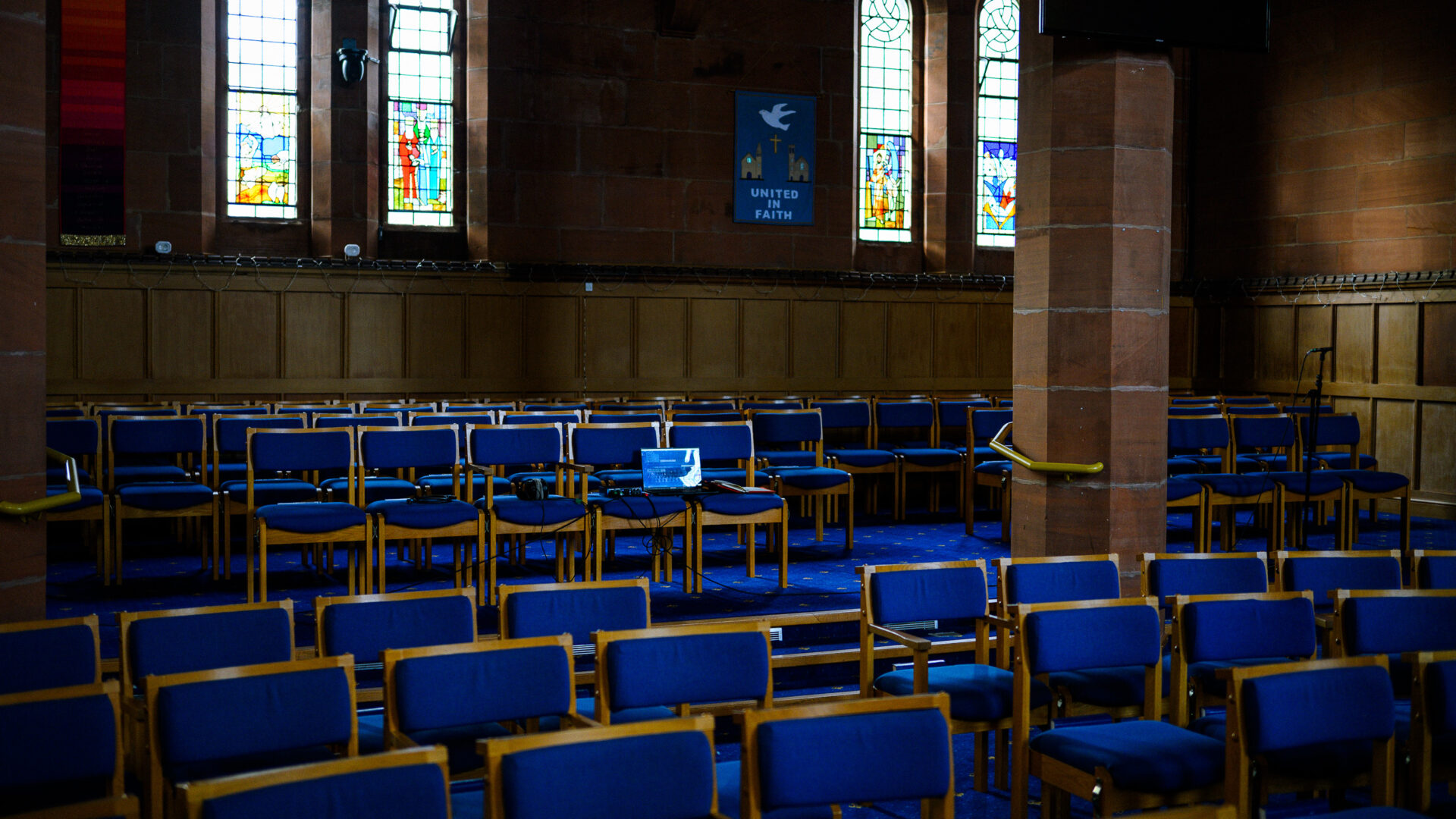
Ever since I heard of them a few years ago, I’ve been very curious about the prospect of recording my own Impulse Responses to use as reverbs. I have a relationship with several churches in my local area which are all architecturally diverse, and I thought it may be a fun project to sample their acoustics.

I worked on this project with a college friend, fellow Engineer Kevin O’Brien.
It was a pretty interesting process. There are plenty of other resources you can find on the science behind it which I’ll include at the end, but the gist is that a short transient (or sine wave sweep, if you have a reference-grade speaker) is produced in a space, and a microphone records the resulting reverberation. This is then processed in your DAW and can be used to mimic the sound of that space.
So far, we’ve recorded in two buildings: Burnside Blairbeth Parish Church, and Fernhill and Cathkin Parish Church. Burnside is a 1911 construction in a traditional style, though has been renovated in 2002 and fitted with carpets and chairs rather than pews. By contrast, Fernhill is a modernist building from the mid-century, featuring a wider sanctuary with a lower ceiling. We noted that Fernhill’s natural acoustics were very pleasing to the ear.
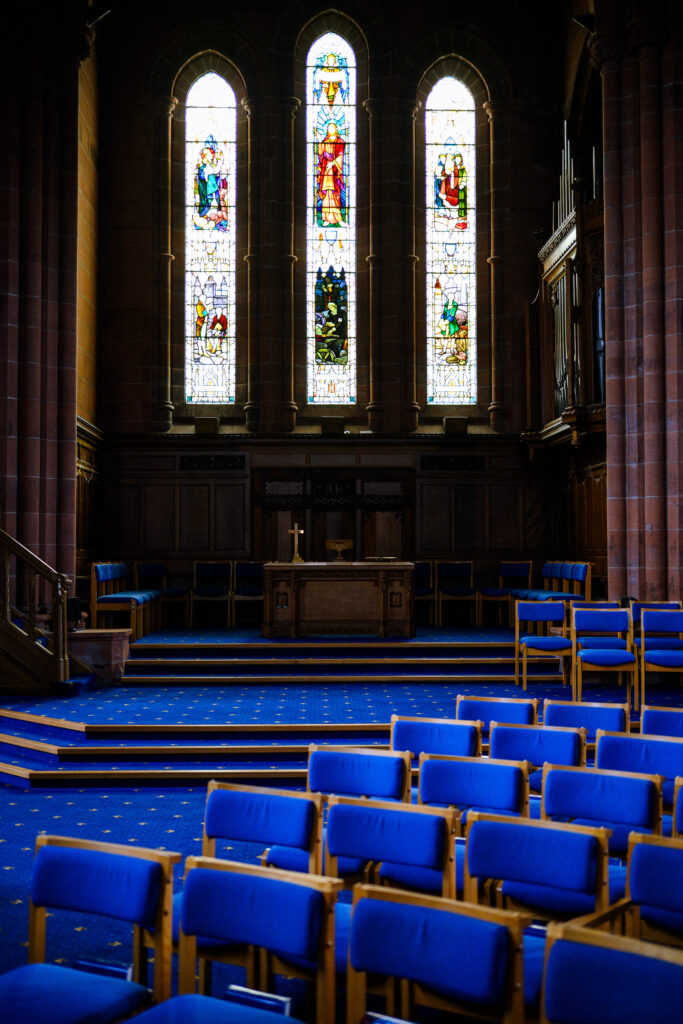
Our process was quite simple; we maneuvered round the room, clapping to imitate the balloon which we would be popping, and listening for acoustic anomalies and sweet spots. We’d then position the mics at an appropriate distance for the level of ambiance we wished to capture, and record. Setting gain was a little challenging, but we estimated it with a loud clap, leaving plenty of headroom. This quite consistently landed us at -6dbFS before clipping.
Equipment
We used two Line Audio CM4s — wide cardioid condensers with a shockingly flat response — in a variety of configurations. As this was our first time doing this, we experimented with XY, ORTF, and AB Spaced Pairs.
These were gained into a PreSonus Studo 26c at 24bit, 192kHz. The high sample rate was chosen for the opportunity to mangle the IRs if we desired; the recordings being so short the drawback of larger file size being a non-issue.
Audio was recorded into Reaper 7, and later edited in iZotope RX 11 to denoise.
Once I am happy with the results, I’ll post them on this site for free.